
Verification Pipeline Design
JuLC joins two independently produced inputs: the exact UPLC selected from the contract blueprint and a closed, canonical security-property IR. It generates a reproducible Lean workspace, runs the pinned Blaster and Z3 toolchain, and classifies the observed result in a hash-bound certificate.
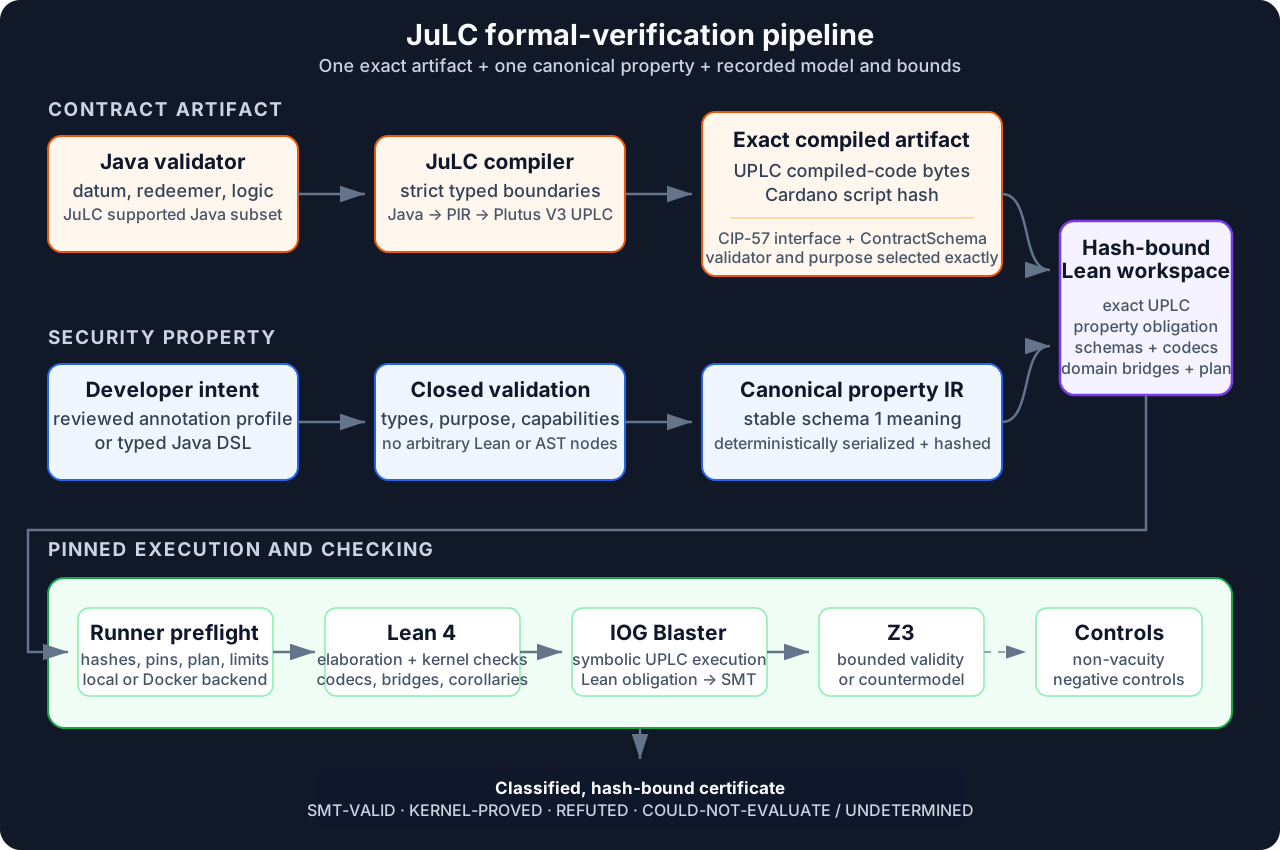
1. Compile and identify one exact artifact
Section titled “1. Compile and identify one exact artifact”The ordinary JuLC compiler turns the supported Java contract into Plutus V3 UPLC. Blueprint generation supplies the compiler-owned datum/redeemer schema and purpose-indexed validator interfaces.
Verification selects exactly one interface by validator and purpose. JuLC checks both the compiled-code digest and Cardano script hash. The proof is therefore about those exact bytes—not about all possible outputs of the Java source or the compiler in general.
2. Build one canonical property
Section titled “2. Build one canonical property”A developer can choose either frontend:
- reviewed annotations such as
@RequiresSigner; or - an explicit specification written with the typed Java DSL.
Annotations lower into the same stable schema-1 DSL IR as explicit specifications. The DSL worker executes trusted project Java, but its output is not trusted as an arbitrary program: the parent process decodes and validates a closed AST, rechecks contract and ledger types, purpose compatibility, domain selection, and capability admission, then canonicalizes and hashes the result.
Arbitrary Lean text and user-defined AST nodes are not accepted. Adding new proof vocabulary requires reviewed Java IR, validation, Lean rendering, model semantics, and controls.
3. Join artifact and property
Section titled “3. Join artifact and property”Workspace generation binds the selected artifact, canonical property, schema, ledger domain, execution fuel, recursive decode depth, dependency revisions, and runner plan. Generated Lean includes, as needed:
- the exact UPLC program and execution premise;
- strict contract types and
Datacodecs derived from the blueprint; - the typed property obligation;
- pinned Cardano ledger-domain predicates;
- kernel-checked inclusion bridges and corollaries; and
- non-vacuity and negative-control checks.
Changing a bound, property, generated Lean file, runner script, selected interface, or artifact changes a recorded hash or fails preflight.
4. Run Lean, Blaster, and Z3
Section titled “4. Run Lean, Blaster, and Z3”The same generated workspace runs through either backend:
- local uses the exact supported Lean/Lake and Z3 toolchain on the host;
- Docker builds the reviewed pinned environment, then runs proof commands without network access after dependency acquisition.
Lean is the language and checking environment for the generated models and lemmas. IOG Blaster symbolically models UPLC execution and translates the admitted obligation to SMT. Z3 searches that bounded model for validity or a counterexample.
These roles matter: SMT-VALID relies on Blaster’s translation and Z3 through
a solver axiom; it is not a theorem reconstructed solely by Lean’s kernel.
Codec controls, domain bridges, and corollaries identified as kernel-checked do
receive ordinary Lean kernel checking.
5. Classify and bind the result
Section titled “5. Classify and bind the result”JuLC authenticates each expected runner step using its exit code and output marker. Unknown, missing, timed-out, or inconsistent observations fail closed. The main classifications are:
SMT-VALID— the bounded translated obligation was established;KERNEL-PROVED— an admitted ordinary Lean theorem was kernel-checked;REFUTED— Blaster found a countermodel in the recorded modeled domain; andCOULD-NOT-EVALUATEorUNDETERMINED— JuLC did not establish the property.
The certificate records the exact artifact, property, domain, assumptions, bounds, backend, tool revisions, generated-source hashes, phase outcomes, and counterexample qualification. It is the statement to review and archive; the terminal summary is only a convenience view.
Trust boundary
Section titled “Trust boundary”| Component | Role | What remains trusted or bounded |
|---|---|---|
| JuLC compiler | Produces the selected UPLC and contract schema | The pipeline does not prove general Java-to-UPLC compiler correctness |
| Strict boundaries and codecs | Give datum/redeemer types their canonical on-chain meaning | Only admitted types and recorded recursive depth are covered |
| Typed DSL and promotion | Define and validate the named property | Missing security properties remain the developer’s responsibility |
| Pinned CardanoLedgerApi model | Defines the selected ledger-domain premise | Coverage is limited to the pinned model and explicit domain bridge |
| Lean | Elaborates generated definitions and kernel-checks ordinary lemmas | SMT-VALID is not solely a Lean-kernel result |
| Blaster | Symbolically models UPLC and translates obligations | Translation and supported builtin coverage are trusted limitations |
| Z3 | Establishes validity or finds a bounded countermodel | Results are relative to the recorded formula, fuel, and solver behavior |
| JuLC runner | Enforces hashes, plans, timeouts, and result classification | A certificate covers only the named properties it records |
Typical flow
Section titled “Typical flow”# 1. Build the contract and its purpose-indexed blueprint.julc build .
# 2a. Verify a reviewed annotation profile.julc verify . --validator AuthorizedStateValidator --backend docker
# 2b. Or generate a typed model and verify an explicit DSL specification.julc verify dsl-init . --validator AuthorizedStateValidator \ --purpose spending --package verification --class AuthorizedStateModel \ --out build/verification-dsl/src/verification/AuthorizedStateModel.java
julc verify dsl . --validator AuthorizedStateValidator \ --purpose spending --spec-class verification.AuthorizedStateSpec \ --spec-classpath "build/verification-dsl/classes:$JULC_JAR" \ --backend docker --force
# 3. Reproduce an already generated, hash-bound workspace.julc verify run verification/authorized-state-validator --backend dockerContinue with Annotation Profiles for the shortest reviewed workflow or Typed Java DSL for custom composition.